
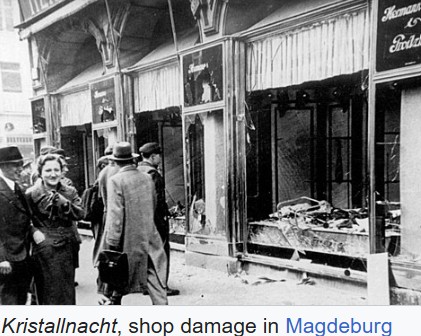
The 80th anniversary of Kristallnacht (Night of Broken Glass) when rioters ransacked Jewish homes, hospitals and schools in Germany and Austria was recently commemorated at Australian Catholic University (ACU) in Melbourne with a musical/theatre performance.
The world premiere, organised by musical director and international composer Warren Wills and ACU education lecturer Dr Beth Rankin comprised up to 200 actors, musicians and singers.
Kristallnacht or the Night of Broken Glass, occurred in November 1938 when paramilitary forces and civilians rampaged against Jewish people affecting more than 260 synagogues and over 7,000 businesses. The official death toll was put at 91 but historians believe the figure was much higher. In addition, 30,000 Jewish men were arrested and sent to concentration camps.
The musical/theatre project was told through the eyes of Indigenous human rights activist, William Cooper, a Yorta Yorta man, who protested the treatment of Jews leading up to World War 2. Cooper was born in 1861 and lived on missions and state-funded reserves in New South Wales and Victoria for much of his life.
The Night of Broken Glass was a performance of music and dance that united and promoted understanding of different cultures, faiths and generations. The event included the stories of Jewish survivor of Kristallnacht, Kurt Wildberg; the son of the “Tattooist of Auschwitz”, Gary Sokolov and Uncle Alf Turner who’s the grandson of William Cooper.
Issues around social justice and metal health have always been close to Mr Wills’ heart. He described the Melbourne project as “socially inclusive and life-affirming”, bringing together disparate groups who wouldn’t usually perform together.
“It was a colourful pot pouri of different Australian cultures and of people who understand the need to champion human rights,” said Melbourne-based Mr Wills. “It was a celebration of different cultures which is what Australia represents today. It’s important to stand together and recognise the importance of human rights.
“Staff and students from ACU, children and refugees/new immigrants to Australia and choirs such as The Choir of Hard Knocks and Men Aloud were all involved.”
Mr Wills, who has worked with thousands of children on numerous projects for more than 20 years, said William Cooper was an outstanding Australian who deserved to be recognised for his courage.
“Despite the poor living conditions of his own people, William Cooper was angry at how Jews were being treated in Europe. He stood up for what he believed in and in 1938 as a 78-year-old he walked from his Footscray home to the German consulate in South Melbourne to protest the treatment of Jews, said Mr Wills.
His courageous action was formally recognised in 2010 with an education memorial, established in his honour at a Jerusalem museum. “I hope the people who attended were moved because it’s a very inspirational story and I was keen to highlight the need for respect for all cultures and to remember that tragic incident 80 years ago,” Mr Wills said.
“When you see what’s happening in different parts of the world today, the need to highlight injustice has never been so important.”
 David B Ahern